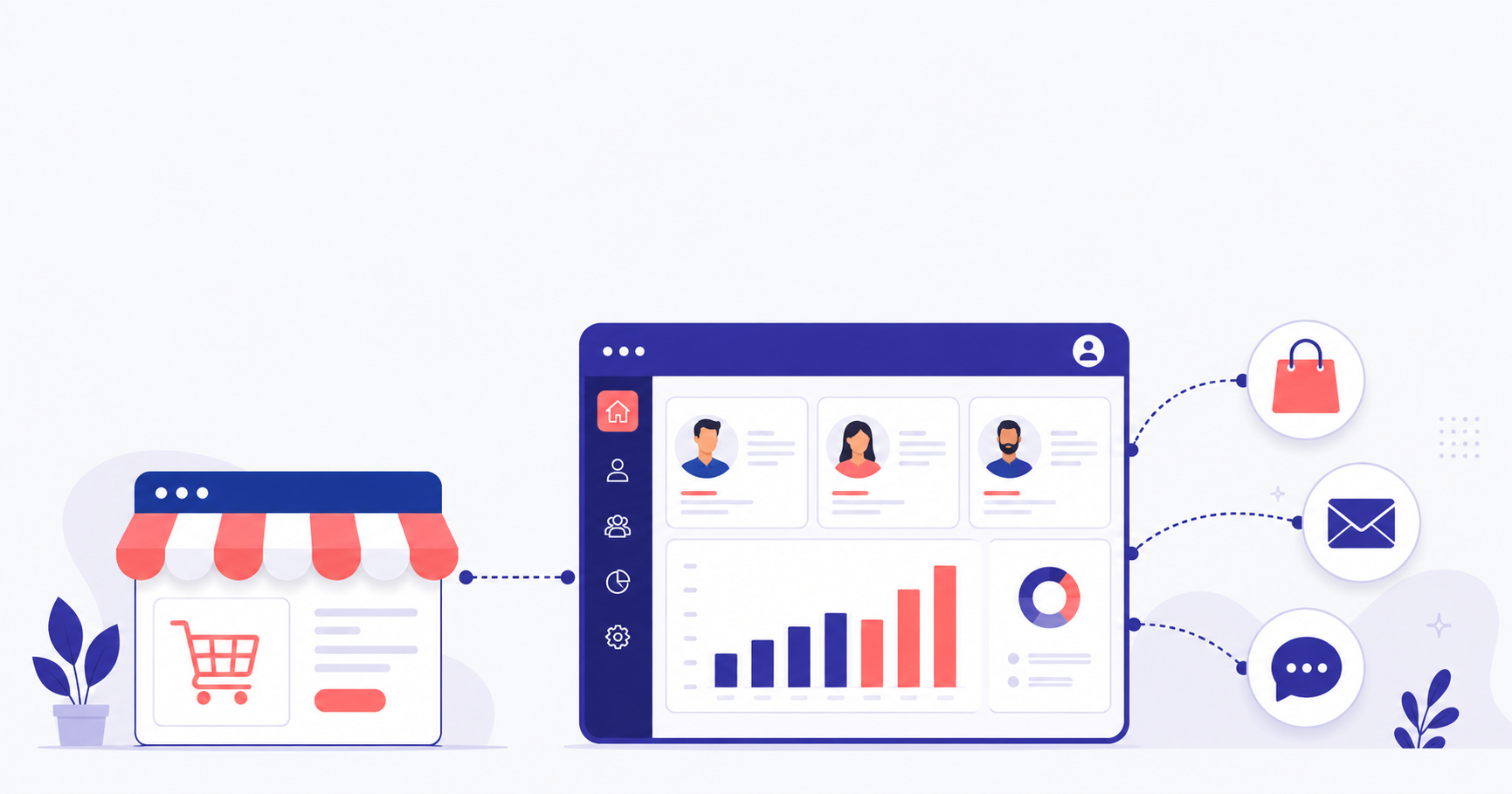
You already know the math: it costs five to seven times more to win a new customer than to keep one you already have. So why do so many online stores still run their customer relationships out of a spreadsheet, a Shopify dashboard, and an inbox full of “did my order ship?” emails?
Picking the best CRM for E-commerce businesses in 2026 isn’t about finding the tool with the most features — it’s about finding the one that fits how your store actually makes money. A CRM built for B2B sales teams tracks deals moving through a pipeline. An ecommerce CRM needs to track something different: browsing behavior, cart abandonment, repeat purchase rate, and customer lifetime value across thousands (or millions) of shoppers who will probably never talk to a human on your team.
We compared seven platforms — from marketing-first tools like Klaviyo to full-stack systems like HubSpot and Salesforce — based on ecommerce integration depth, automation quality, and real 2026 pricing. Here’s what actually works, and for whom.
What Makes a CRM “Ecommerce-Ready”?
Before the comparison, it’s worth being specific about what separates a genuine CRM for online store operations from a repurposed sales tool:
- Native store integrations — one-click sync with Shopify, WooCommerce, BigCommerce, or Magento, not a clunky Zapier workaround
- Behavioral segmentation — grouping customers by what they bought, browsed, or abandoned, not just by “lead status”
- Order and revenue data in the customer record — so support and marketing teams can see purchase history without switching tabs
- Automated lifecycle flows — welcome series, abandoned cart, post-purchase, win-back — triggered by store events
- Scalable pricing — most stores have far more contacts than “deals,” so per-contact pricing tiers matter more than per-seat ones
With that lens, here’s how the major players stack up.
The Best CRM for E-commerce Businesses, Compared
| Tool | Best For | Starting Price | Key Feature |
|---|---|---|---|
| HubSpot | Stores that want marketing, sales, and support unified in one platform | Free CRM; paid plans from $20/seat/mo, Professional from ~$890/mo | All-in-one hub with deep reporting, though automation is gated behind Professional |
| Zoho CRM | Budget-conscious stores, especially those running B2B/wholesale alongside D2C | Free tier available; paid plans from ~$14–20/user/mo | Deep customization and Shopify/WooCommerce connectors via Zoho Marketplace |
| Klaviyo | Marketing-led D2C brands prioritizing email/SMS segmentation over sales pipelines | Free up to 250 contacts; paid plans scale with list size | Ecommerce-native customer data platform with granular purchase-based segmentation |
| ActiveCampaign | Stores that want automation and light CRM functionality in one plan | Plans from roughly $15–$29/mo depending on contact volume | Strong automation-and-CRM balance, built-in SMS and lead scoring |
| Salesforce | Large ecommerce operations with dedicated IT and 10+ reps | From $25/user/mo, scaling to $500+/mo for top tiers | Enterprise-grade customization, but requires real implementation investment |
| Omnisend | Smaller stores wanting email marketing and light CRM in one tool | Free tier available; paid plans start around $16/mo | Purpose-built ecommerce integrations across Shopify, WooCommerce, and Magento |
| Bitrix24 | Stores that want CRM plus an actual storefront builder bundled in | Free tier available; paid plans from ~$81/mo | Built-in online store tools alongside multichannel messaging (WhatsApp, Instagram DM, etc.) |
HubSpot: The All-in-One Choice
HubSpot remains the default answer for stores that have outgrown “marketing tool + separate helpdesk + spreadsheet CRM” and want one system of record. The free CRM is genuinely usable — unlimited users, contact and deal records, live chat — which makes it a low-risk starting point.
The catch is the same one HubSpot has had for years: real marketing automation, custom reporting, and workflow automation live behind the Professional tier, which runs close to $890 a month for the Marketing Hub once onboarding fees are factored in. For a store already generating consistent revenue and wanting one unified platform across marketing, sales, and support, that cost can pay for itself. For a five-person team still finding product-market fit, it’s a steep jump from the free tier.
Zoho CRM: The Value Pick for Flexible Operations
Zoho is the CRM most likely to fit a store that isn’t purely D2C — think brands running wholesale accounts, a marketplace presence, and a Shopify storefront simultaneously. Its lower-cost tiers include features that competitors reserve for higher plans, and its Shopify and WooCommerce connectors (via Zoho Marketplace) cover the basics without needing a developer.
The trade-off is interface complexity. Zoho gives you a lot of configuration knobs, which is exactly what makes it powerful for hybrid B2B/B2C operations — and exactly what makes new users describe the learning curve as overwhelming.
Klaviyo: Built for D2C Marketing, Not Traditional Sales Pipelines
Klaviyo isn’t a CRM in the traditional sense — there’s no deal pipeline, no sales rep activity tracking. What it does instead is arguably more useful for a pure ecommerce brand: it functions as a customer data platform, pulling in every purchase, browse, and click event and letting you segment customers with precision most CRMs can’t match (“bought twice in the last 90 days but hasn’t opened the last three emails,” for example).
If your growth engine is email and SMS marketing rather than a sales team closing deals, Klaviyo’s segmentation depth usually delivers more practical ROI than a traditional CRM’s pipeline features, which tend to go unused in a self-service store.
ActiveCampaign: Automation-First With CRM Built In
ActiveCampaign sits in the middle ground — stronger automation than a pure email tool, lighter sales-pipeline functionality than Salesforce or HubSpot. Its contact and lead scoring, combined with SMS and dynamic content, make it a solid pick for stores that want one platform handling both marketing sequences and light sales follow-up, without paying enterprise prices.
Salesforce: The Enterprise Standard
Salesforce is the right call once a store has real scale: multiple sales reps, complex fulfillment or B2B workflows, and — critically — the internal (or agency) resources to configure it properly. It’s the most customizable platform on this list by a wide margin, but that flexibility comes with implementation cost and a genuine learning curve. For a 3-person startup, it’s usually overkill; for a 10-figure ecommerce brand with dedicated ops staff, it’s often the only platform with enough depth.
Omnisend: Lightweight and Ecommerce-Native
Omnisend leans into simplicity — it’s built specifically for online stores, with native integrations across the major platforms and automated flows (cart abandonment, welcome series, post-purchase) that are ready to go without heavy setup. It won’t replace a full CRM for a store with a sales team, but for a lean team wanting marketing automation and basic customer data in one place, it’s a fast, affordable starting point.
Bitrix24: CRM Plus Storefront in One
Bitrix24’s differentiator is that it bundles CRM functionality with actual online store-building tools and a wide range of messaging channel integrations (WhatsApp, Telegram, Instagram DMs). It has a higher entry price than Zoho or Omnisend, but for a store that wants to consolidate its tech stack rather than stitch together five separate tools, that price can offset what you’d otherwise pay for a separate store builder or omnichannel messaging tool.
How to Choose the Right One for Your Store
There’s no single best answer — the right platform depends on three things:
- Store size and revenue. Early-stage stores rarely need Salesforce-level customization; that budget is usually better spent on Klaviyo or Omnisend automation.
- Business model. Pure D2C brands lean toward marketing-native tools like Klaviyo. Stores with wholesale, B2B, or multichannel sales lean toward Zoho or HubSpot.
- Team structure. If you have dedicated sales reps closing larger orders, a traditional CRM pipeline (Salesforce, HubSpot, Zoho) earns its keep. If your team is mostly marketing and support, a customer data platform like Klaviyo often delivers more value per dollar.
FAQ
What is the best CRM for a small ecommerce business? For most small stores, Zoho CRM or Omnisend offer the best balance of price and ecommerce-specific features. Zoho works well if you also handle B2B or wholesale orders; Omnisend fits pure D2C stores wanting fast setup.
Is Klaviyo a CRM or just an email marketing tool? Klaviyo started as email marketing but now functions as a full customer data platform, tracking purchase and browsing behavior for segmentation. It lacks a traditional sales pipeline, so it’s best paired with (or instead of) a CRM depending on whether your store relies on a sales team.
Does Shopify have a built-in CRM? Shopify’s native admin includes basic customer profiles and order history, but it lacks the automation, segmentation, and multichannel messaging that dedicated ecommerce CRMs provide. Most growing stores connect a third-party CRM via Shopify’s app integrations.
How much should an ecommerce business budget for CRM software? Small stores can start free or under $30/month with tools like Zoho or Omnisend. Mid-size stores investing in real marketing automation typically budget $200–$1,000/month. Enterprise operations with Salesforce or HubSpot Enterprise can run $3,000–$4,500+/month once seats and onboarding are included.
What’s the difference between a CRM and an ecommerce customer data platform (CDP)? A traditional CRM is organized around deals and sales reps. A CDP like Klaviyo is organized around individual customer behavior — purchases, page views, email engagement — which is usually a better fit for self-service online stores without a sales team.
Conclusion
If you need one platform to unify marketing, sales, and support and you’re ready to invest in the Professional tier, HubSpot is the safest all-around pick. If budget is the priority and your store runs any B2B or wholesale relationships alongside D2C, Zoho CRM delivers the most value per dollar. And if your growth is driven almost entirely by email and SMS marketing rather than a sales team, skip the traditional CRM altogether and put your budget into Klaviyo. Start with the platform that matches how you actually sell today — you can always migrate up as the business scales.
Read More :
HubSpot vs Zoho CRM: Which Is Better for Small Business?


2 Comments