
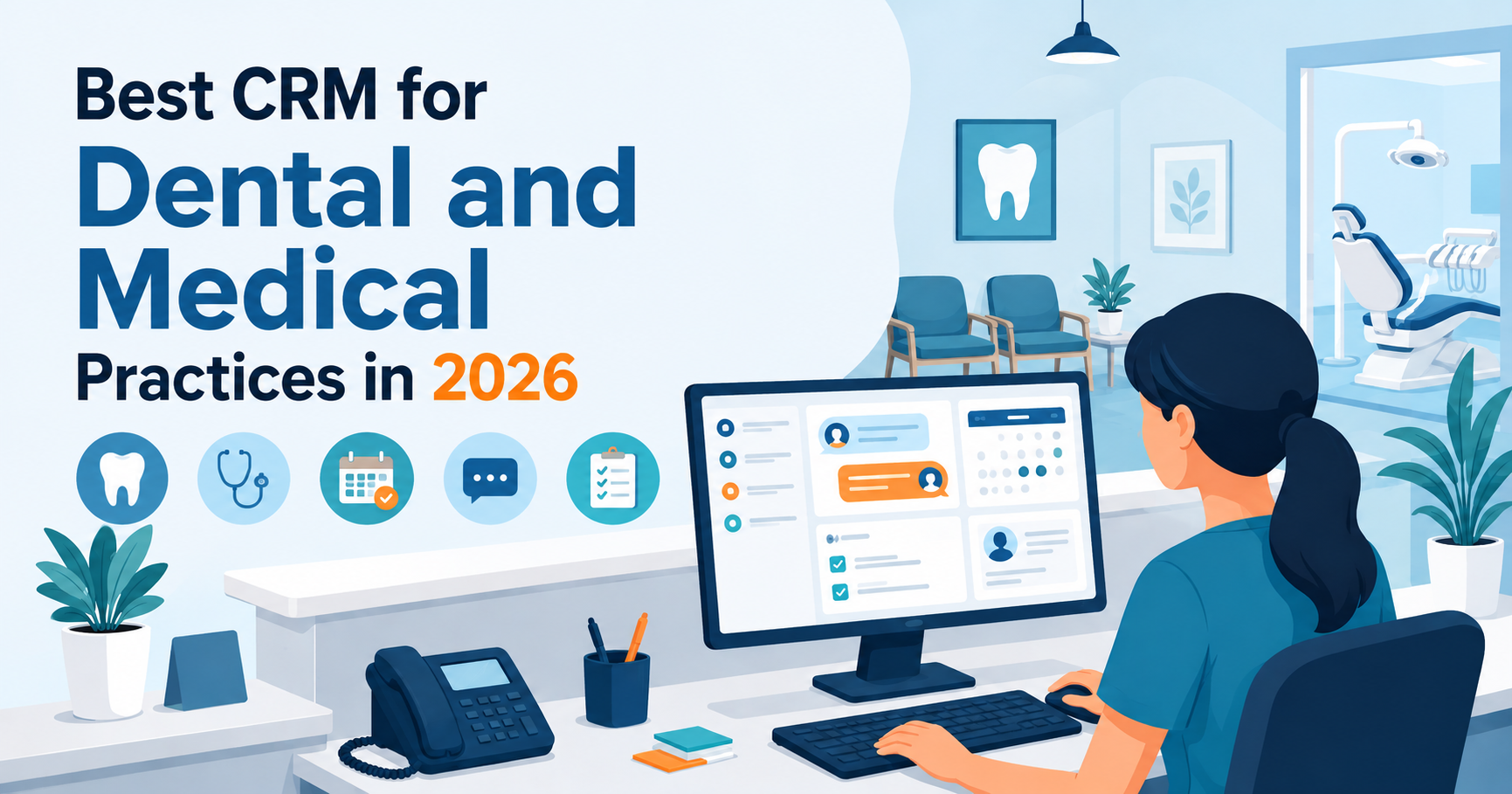
A front desk that’s still tracking recalls on sticky notes is losing patients — not to a competitor down the street, but to its own inbox. Missed follow-ups, no-shows nobody chased, and a referral that went cold because no one logged it: these are the quiet leaks that a good CRM plugs. If you’re comparing the best CRM for dental and medical practices, you’re really comparing how well each tool handles three things — patient communication, scheduling follow-through, and reporting you can actually act on.
This guide breaks down the top healthcare-focused CRM platforms, what they cost, who they’re built for, and how to pick the right one without paying for features you’ll never touch.
What Makes a CRM “Healthcare-Ready”?
Not every CRM belongs in a medical or dental setting. Before comparing tools, it helps to know what separates a general sales CRM from one built for patient relationships:
- HIPAA compliance — Business Associate Agreements (BAAs), encrypted storage, and audit logs aren’t optional.
- Two-way texting and automated reminders — reduces no-shows without adding staff workload.
- PMS/EHR integration — a CRM that doesn’t talk to your practice management system just creates a second system of record nobody trusts.
- Recall and reactivation campaigns — dental hygiene recalls, annual physicals, and lapsed-patient outreach need to run automatically, not manually.
- Reputation management — review requests tied to completed visits, not blasted to everyone.
Best CRM for Dental and Medical Practices: Top Picks Compared
| CRM | Best For | Starting Price | Key Feature |
|---|---|---|---|
| Weave | Multi-location dental & medical groups | ~$399/mo (custom quote) | Unified phone, text, and payments tied to patient records |
| NexHealth | Practices wanting deep EHR/PMS sync | Custom pricing | Real-time two-way sync with major EHR/PMS platforms |
| RevenueWell | Dental practices focused on recall/reactivation | ~$300–400/mo | Automated recall campaigns and patient reactivation |
| Solutionreach | Practices prioritizing patient engagement at scale | Custom pricing | Broadcast messaging + appointment reminders across specialties |
| HubSpot (with HIPAA add-on) | Practices that also run marketing funnels | $0–$800+/mo | Flexible general CRM with marketing automation, HIPAA via BAA add-on |
| DentalRem / Lighthouse 360 | Small-to-mid dental offices | ~$300/mo | Simple recall reminders and review generation |
Pricing changes often and many vendors require a custom quote based on practice size — confirm current numbers directly with the vendor before budgeting.
Weave: Best for Multi-Location Practices
Weave built its reputation by combining phones, texting, payments, and reviews into one dashboard tied to the patient chart. For a multi-provider dental or medical group, that means front-desk staff aren’t toggling between four different tools to handle one patient interaction. The tradeoff is cost — Weave leans toward larger practices with the budget to match.
NexHealth: Best for EHR/PMS Integration
If your biggest frustration is data living in two disconnected systems, NexHealth’s selling point is real-time synchronization with platforms like Dentrix, Epic, and athenahealth. It’s less of a marketing CRM and more of an operational backbone — appointment requests, patient records, and communication all stay in sync automatically.
RevenueWell: Best for Dental Recall and Reactivation
RevenueWell was built specifically for dental practices and it shows in the recall automation — hygiene reminders, birthday campaigns, and reactivation sequences for patients who haven’t booked in 12+ months. Practices that struggle with hygiene retention tend to see the fastest ROI here.
Solutionreach: Best for Engagement at Scale
Solutionreach serves both dental and medical practices with broadcast-style messaging (think mass reminders, health campaigns, seasonal outreach) alongside individual patient texting. It suits larger practices or DSOs/MSOs that need to message thousands of patients without it feeling impersonal.
HubSpot: Best for Practices That Also Run Marketing Campaigns
HubSpot isn’t healthcare-specific, but with a signed BAA and its HIPAA-compliant configuration, some practices — especially those running paid ads, email newsletters, or multi-location marketing — prefer its flexibility and reporting depth over a narrower healthcare CRM. It requires more setup work to get HIPAA-ready than a purpose-built tool.
Lighthouse 360 / DentalRem: Best for Small Dental Offices
For a single-location dental practice that mainly needs appointment reminders, recall postcards/texts, and automated review requests, a lighter tool like Lighthouse 360 avoids paying for enterprise features a small office won’t use.
How to Choose the Right CRM for Your Practice
- Practice size and locations — a single-location office rarely needs what a 12-location DSO needs.
- Integration with your existing PMS/EHR — ask vendors for a live demo of the actual sync, not just a features list.
- Staff bandwidth — the best CRM is the one your front desk will actually use daily. A powerful tool that’s confusing gets abandoned within a month.
- Compliance requirements — confirm a signed BAA is included, not an upsell.
- Reporting you’ll actually read — no-show rates, recall conversion, and review volume matter more than vanity dashboards.
Frequently Asked Questions
What is the best CRM for a small dental practice? For single-location dental offices, lighter tools like Lighthouse 360 or RevenueWell tend to fit better than enterprise platforms like Weave, since they focus on recall and reminders without a steep setup process.
Do medical practices need a HIPAA-compliant CRM? Yes — any CRM storing or transmitting patient information (names, appointment details, health-related messages) needs a signed Business Associate Agreement and HIPAA-compliant infrastructure, regardless of practice size.
Can a CRM replace my practice management software? No. A CRM handles communication, marketing, and relationship tracking; your PMS/EHR remains the system of record for clinical and billing data. The two should integrate, not compete.
How much does a medical or dental CRM cost? Most healthcare CRMs run $300–$800/month depending on practice size and features, though several vendors require a custom quote for multi-location groups.
What’s the difference between a CRM and a patient engagement platform? In practice, the terms overlap heavily in healthcare marketing. A CRM technically tracks relationships and data; a “patient engagement platform” usually adds automated messaging and outreach on top. Most vendors in this space now do both.
Conclusion
There’s no single best CRM for every dental or medical practice — the right pick depends on whether your biggest pain point is recall automation, EHR integration, multi-location communication, or marketing reach. For most single-location dental offices, RevenueWell or Lighthouse 360 hit the sweet spot of price and simplicity. Larger groups juggling multiple locations or complex PMS integrations will get more value from Weave or NexHealth. Whichever you choose, prioritize a signed BAA, real staff adoption, and a live demo of the actual patient workflow before signing a contract.
Read More :




One Comment