
Best CRM for Nonprofit Organizations (2026)
A donor gives once, gets a generic thank-you email six weeks later, and never gives again. That’s not a fundraising problem — it’s a systems problem, and it’s exactly what happens when donor data lives in three spreadsheets and one overworked development director’s inbox instead of a single, connected CRM.
Nonprofit CRMs aren’t just databases with a mission-driven label slapped on. The best ones track giving history, communication preferences, volunteer hours, and event attendance in one donor record, then use that context to automate the follow-up that actually keeps supporters engaged. Pick the wrong one, though, and you’ll end up with a tool built for enterprise sales teams that has no idea what a “pledge” or a “giving anniversary” even is.
This guide breaks down the best CRM for nonprofit organizations in 2026 — matched to organization size, budget, and how your team actually fundraises — so you’re not paying for enterprise complexity you’ll never touch, or outgrowing a tool in eighteen months.
What to Look for in a Nonprofit CRM
Before comparing platforms, it helps to know what actually separates a good nonprofit CRM from a repurposed sales tool:
- True donor profiles. Giving history, household linking, communication preferences, and engagement timeline in one record — not just a name and an email address.
- Built-in online giving. Native donation pages with recurring gift support save you from paying for and integrating a separate giving platform.
- Automated stewardship. Thank-you emails, lapsed-donor alerts, and task reminders that fire automatically instead of relying on someone remembering.
- Volunteer and program tracking. If your work goes beyond fundraising — case management, volunteer shifts, program outcomes — the CRM should handle that natively or integrate cleanly with what does.
- Honest nonprofit pricing. Many platforms offer nonprofit-specific discounts or tiered pricing based on budget size rather than flat per-seat fees.
The Best CRM for Nonprofit Organizations, Compared
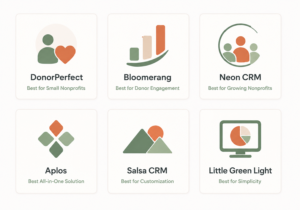
| CRM | Best For | Starting Price | Key Feature |
|---|---|---|---|
| Bloomerang | Organizations focused on donor retention | ~$125/mo | Built-in engagement and generosity scoring to flag at-risk donors |
| Little Green Light | Small nonprofits with tight budgets | ~$45/mo | Full donor management at one of the lowest entry price points |
| Neon CRM | Growing orgs needing memberships + events + fundraising in one system | ~$99/mo | Native event ticketing and membership management alongside donor CRM |
| DonorDock | Small-to-mid teams wanting one login for everything | ~$79/mo | Action Board that surfaces daily donor-outreach tasks automatically |
| Virtuous | Mid-size orgs scaling relationship-driven fundraising | Custom pricing | AI-powered “Responsive Fundraising” automation and donor insights |
| Salesforce Nonprofit Cloud | Larger nonprofits needing deep customization | Free/discounted via Salesforce.org grant | Enterprise-grade customization built on the core Salesforce platform |
Bloomerang: Best for Donor Retention
Bloomerang was built around a simple premise: it’s cheaper to keep a donor than to acquire a new one, so the platform is structured around retention rather than just capturing gifts. Its engagement and generosity scoring flags which donors are pulling away before they’ve fully lapsed, giving your team a chance to re-engage instead of just noticing the drop-off in a year-end report. It also includes social listening and peer-to-peer fundraising tools. The tradeoff is that Bloomerang is squarely a fundraising CRM — if you need heavy program or case management alongside donor tracking, you’ll likely need a second system.
Little Green Light: Best for Small Nonprofits on a Tight Budget
Little Green Light consistently comes up as the go-to option for small, volunteer-run, or newly formed nonprofits that need real donor management without an enterprise price tag. It covers the fundamentals well — donor profiles, gift tracking, and reporting — without burying them under features a five-person org will never use. It’s not going to compete with Neon CRM or Virtuous on automation depth or AI features, but for organizations whose main need is simply “get off spreadsheets,” it’s one of the most cost-effective ways to do that.
Neon CRM: Best All-in-One for Fundraising, Events, and Memberships
If your organization runs membership programs, ticketed events, and fundraising campaigns all at once, Neon CRM is built to keep all of it in a single system instead of stitching together separate event and donor tools. It gives a genuinely unified view of a supporter — donor, member, and event attendee all in one profile — rather than three disconnected records. The setup is more involved than a lighter tool like Little Green Light, so it fits organizations that have outgrown a bare-bones donor database and need the extra structure.
DonorDock: Best for One Login, One Bill
DonorDock‘s pitch is consolidation — donor management, online giving, email and text messaging, and even light project management under one platform and one subscription. The standout feature is the Action Board, which functions like a daily fundraising coach, surfacing who needs a thank-you, who’s about to lapse, and whose giving anniversary is coming up, so stewardship happens by default rather than by memory. For small-to-mid teams juggling too many disconnected tools, that consolidation alone can justify the switch.
Virtuous: Best for Scaling Relationship-Driven Fundraising
Virtuous leans hardest into AI-assisted, relationship-first fundraising, aiming to help teams treat donors as whole people rather than transaction records. Automated workflows handle much of the day-to-day stewardship, and donor intelligence features help larger teams prioritize where to spend limited outreach time. It’s built more for mid-size organizations with a dedicated development team than for a one-or-two-person shop, and pricing is custom rather than published, so it’s worth a demo before committing.
FAQ: Best CRM for Nonprofit Organizations
What is the best free or low-cost CRM for a small nonprofit? Little Green Light is widely considered the strongest low-cost option for small or newly formed nonprofits, and Salesforce Nonprofit Cloud is available free or heavily discounted to qualifying nonprofits through Salesforce.org.
What’s the difference between a nonprofit CRM and a regular business CRM? A nonprofit CRM is built around donor relationships and giving history instead of sales deals — it typically includes donation pages, pledge tracking, household linking, and stewardship automation that a standard sales CRM doesn’t offer natively.
Which nonprofit CRM is best for donor retention specifically? Bloomerang is generally the top pick here, built specifically around engagement scoring and re-engagement workflows designed to catch lapsing donors early.
Do nonprofit CRMs handle volunteer management too? Many do to varying degrees — Neon CRM and DonorDock both offer volunteer and event tracking alongside donor management, though organizations with heavy case-management needs may still want a specialized program-management tool alongside their CRM.
Is Salesforce a good CRM for nonprofits? Salesforce Nonprofit Cloud can be a strong fit for larger, more complex organizations, especially since it’s often free or discounted through Salesforce.org — but it typically requires more setup and technical support than purpose-built nonprofit CRMs like Bloomerang or Little Green Light.

The Verdict
There’s no single best CRM for nonprofit organizations — there’s a best fit for your size, budget, and how your team fundraises. If donor retention is your top priority, Bloomerang is purpose-built for it. If budget is the constraint, Little Green Light gets you off spreadsheets affordably. If you’re running events and memberships alongside fundraising, Neon CRM keeps it unified. And if you’re a larger organization ready for enterprise-level customization, Salesforce Nonprofit Cloud is worth exploring through its nonprofit pricing program. Choose based on what your team will actually use every week, not the platform with the longest feature list.
Read More:
1. Best CRM for Freelancers and Solopreneurs (2026)
2. Salesforce Alternatives for Small Businesses in 2026




One Comment