
Best Web Hosting for Ecommerce Stores in 2026
A shopper adds a product to their cart, the checkout page takes four seconds to load, and they close the tab. That’s not a marketing problem — it’s a hosting problem, and it’s one of the most expensive mistakes an online store owner can make without realizing it’s happening. Every extra second of load time bleeds conversions, and for a store handling real transactions, downtime doesn’t just mean lost visitors — it means lost sales in real time.
Ecommerce hosting isn’t the same problem as hosting a blog or a portfolio site. You’re dealing with product catalogs, checkout flows, payment processing, and traffic that can spike hard during a sale — all of which demand more from your server than a typical content site ever will. The best web hosting for ecommerce stores in 2026 has to deliver speed, uptime, and security by default, not as an expensive add-on you discover you need after your first big sale crashes the site.
This guide breaks down the strongest ecommerce hosting options in 2026, based on platform fit, real performance, and what actually matters as a store scales from a handful of orders a day to real volume.
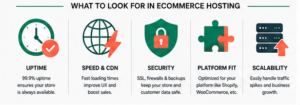
What to Look for in Ecommerce Hosting
Before comparing providers, it’s worth being clear on what separates ecommerce hosting from general-purpose hosting:
- Uptime that’s actually guaranteed. Look for 99.9%+ uptime commitments with real SLAs, not just marketing copy — every minute of downtime is potential lost revenue.
- Built-in speed infrastructure. Server-level caching, a CDN, and fast storage (NVMe/SSD) matter more for ecommerce than almost any other site type, since checkout speed directly affects conversion.
- Real security, not just SSL. A Web Application Firewall, DDoS protection, and automated malware scanning are baseline requirements when you’re processing customer data and transactions.
- Platform fit. Whether you’re running WooCommerce, Shopify, or Magento changes what “good hosting” even means — a WooCommerce-optimized host won’t help a Shopify store, and vice versa.
- Room to scale. Shared hosting works for a small catalog, but growing stores need a clear upgrade path to VPS or cloud hosting without a full migration headache.
Best Web Hosting for Ecommerce Stores, Compared
| Host | Best For | Starting Price | Key Feature |
|---|---|---|---|
| Shopify | Store owners who want an all-in-one platform, no server management | ~$29/mo | 99.99% uptime with hosting fully built into the platform |
| Bluehost | WooCommerce beginners wanting an affordable, well-rounded start | ~$3–10/mo | One-click WooCommerce setup on budget-friendly shared plans |
| Cloudways | Store owners who want managed hosting on top of AWS/DigitalOcean/Google Cloud | ~$14/mo | Choose your own cloud infrastructure with fully managed support |
| Kinsta | Growing WooCommerce stores that need premium managed performance | ~$35/mo | Enterprise-grade caching and auto-scaling built for high-traffic stores |
| SiteGround | Mid-size WooCommerce stores prioritizing support and security | ~$5–15/mo | Proactive security tools plus consistently strong support ratings |
| Liquid Web | Larger stores needing VPS/cloud power and guaranteed uptime | ~$10–30/mo | 100% uptime guarantee on managed cloud/VPS plans |
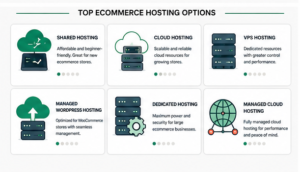
Shopify: Best All-in-One, No Server Management Required
If you’d rather not think about servers, caching, or CDN configuration at all, Shopify bundles hosting directly into its ecommerce platform, and it does it well — 99.99% uptime is treated as the baseline, backed by a global CDN so product pages load quickly regardless of where a shopper is browsing from. The tradeoff is flexibility: you’re building inside Shopify’s ecosystem, which means less control over the underlying infrastructure than a self-hosted WooCommerce store, and ongoing transaction fees unless you use Shopify Payments. For store owners who want simplicity over customization, it remains the easiest path to a fast, reliable store.
Bluehost: Best Affordable Start for WooCommerce
For store owners building on WordPress with WooCommerce, Bluehost offers one of the most approachable entry points — one-click WooCommerce installation, budget-friendly shared plans, and enough built-in ecommerce tooling to get a small catalog live without hiring a developer. It fits stores that are just starting out or migrating an existing catalog over. As the store grows past what shared hosting can comfortably handle, you’ll likely need to upgrade tiers or move to a more performance-focused host, so it’s a strong starting point rather than a permanent home for a fast-scaling store.
Cloudways: Best for Choosing Your Own Cloud Infrastructure
Cloudways takes a different approach than most hosts on this list — instead of running its own servers, it layers managed hosting and support on top of infrastructure from AWS, DigitalOcean, Google Cloud, and others, letting you pick the underlying provider while Cloudways handles the management layer. That gives growing stores real flexibility to scale server resources up during a sale and back down after, without a full replatform. It requires slightly more comfort with technical concepts than a fully packaged host like Bluehost, but the performance and scaling flexibility are hard to match at the price.
Kinsta: Best Premium Managed Hosting for Growing Stores
Once a WooCommerce store is generating serious traffic and revenue, the calculus shifts from “cheapest hosting” to “hosting that won’t cost me sales during a spike.” Kinsta is built for exactly that scenario, with enterprise-grade caching, auto-scaling, and a fully managed environment that removes plugin and server maintenance from your plate entirely. It’s priced well above entry-level shared hosting, but for a store where downtime or slow checkout pages translate directly into lost revenue, the cost is usually easy to justify.
FAQ: Best Web Hosting for Ecommerce Stores
What’s the difference between ecommerce hosting and regular web hosting? Ecommerce hosting is built around the demands of transactions and traffic spikes — stronger security (WAF, DDoS protection), faster caching infrastructure, and higher uptime guarantees — while general hosting is optimized for lighter, more predictable content sites.
Is Shopify or WooCommerce hosting better for a new store? Shopify is the simpler path since hosting, security, and updates are fully managed as part of the platform; WooCommerce (self-hosted on something like Bluehost or Cloudways) gives more control and customization but requires more hands-on management.
Do I need a dedicated server for my ecommerce store? Most small-to-mid stores don’t — shared or cloud hosting from a provider like Bluehost, Cloudways, or SiteGround is sufficient until traffic and order volume grow large enough to justify a VPS or dedicated server.
Does hosting affect my store’s PCI compliance? If you use a payment processor like Stripe or PayPal, you’re not directly handling card data, so full PCI-compliant hosting isn’t strictly required — but strong hosting-level security practices still matter for protecting customer data overall.
What hosting is best for a WooCommerce store expecting high traffic during sales? Kinsta and Cloudways are both strong picks here, since both offer scalable infrastructure and caching built to handle traffic spikes without the checkout experience slowing down.

The Verdict
There’s no single best web hosting for ecommerce stores — there’s a best fit for your platform and growth stage. If you want zero server management, Shopify remains the simplest path. If you’re building on WooCommerce and just getting started, Bluehost is an affordable, approachable entry point. If you want more control and flexible scaling, Cloudways lets you choose your own cloud infrastructure. And once your store is generating real revenue and traffic, Kinsta’s premium managed hosting is built to protect that revenue during peak demand. Match the host to where your store actually is today, with a clear path to upgrade as it grows.
READ MORE:
Best CRM Software for Coaches and Consultants
Best CRM for Nonprofit Organizations








One Comment